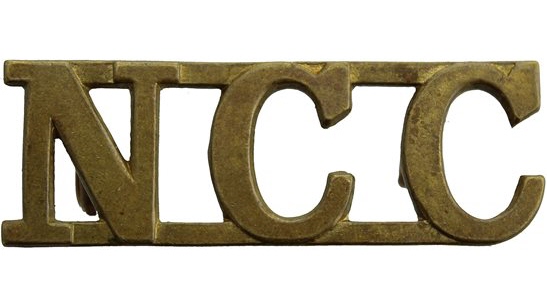
If you know anything about World War I and II you will have heard about the conscientious objectors, men who refused to fight on principle. But you may not have heard of the Non Combatant Corps, the NCC.
When conscription started in the UK in 1916, the army soon realised there were some men who would not, out of conscience, take any part in battles, nor would they carry a gun, but who were prepared to do other jobs such as working in the supply chains of anything but munitions, doing engineering work away from the front etc. So the army created the NCC, Non-Combatant Corps. The conscripts were privates, and the officers were part of the regular army.
Many of these men who refused to fight were Christians, especially Quakers, Methodists and men from the various branches of the Plymouth Brethren. Others were pacifists. All were ridiculed by most of society, in and out of uniform. For example, in 1916 one magazine showed this as a possible coat of arms for the NCC, complete with rabbits, baby’s bottles, maggots and the wording WE DON’T WANT TO FIGHT. CONSCIENCE DOTH MAKE COWARDS OF US ALL.

This was another popular cartoon of the time. The caption says: Oh, you naughty, unkind German – Really, if you don’t desist I’ll forget I’ve got a conscience, and I’ll smack you on the wrist!
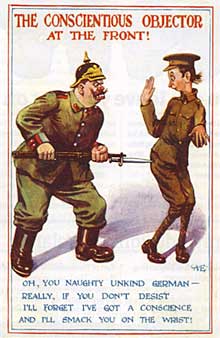
Very soon the letters NCC were said to stand for No Courage Corps. But this was far from the case. Many of the men had to contend with this sort of attitude in their families as well as their communities. Any form of moral objection to war required strength of character as well as the courage of their convictions.
This clipping from “The Globe” of 11 March 1916 is typical. “… a kind of ‘we don’t want to fight’ branch of the army… What are to be the duties of the peaceful brigade we cannot say … [it is] to meet the scruples of those curious creatures who, at the last moment, discovered consciences which forbade them to take up arms. After a short time in the NCCs, we feel sure they will become glad to become soldiers, for they can expect little sympathy or appreciation from either their combatant comrades or the sensible public”.
In 1940 the NCC was re-formed under the same conditions as in WW I. Fairly soon, however, the Army started putting men unfit for combat in the NCC. It was divided into 14 companies, commanded mostly by veteran officers of the First World War and reservists. During the course of the war 6,766 men served in the NCC,
This is where it becomes personal. My father (on the right) joined the NCC, and spent most of the war loading and unloading trains at Lancaster. He was housed in Lancaster Castle, a working prison, where the NCC took over a wing. They slept in the cells, but the doors were not locked!

Twenty or so years later, my father’s pacifist conscience and Christian beliefs were put to the test again. He was a brilliant mathematician, and was offered a job working in the atomic industry at a very high salary. As a teacher with a young family this must have been tempting, but he refused steadfastly. He did not want to work in an industry focused on killing people.
Today, as we remember those who died fighting in the wars of the 20th Century, remember too those who were prepared to stand up and be counted as conscientious objectors and members of the NCC.


















 god-and-dog.com